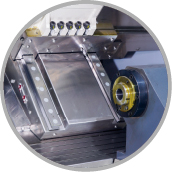

Product Details
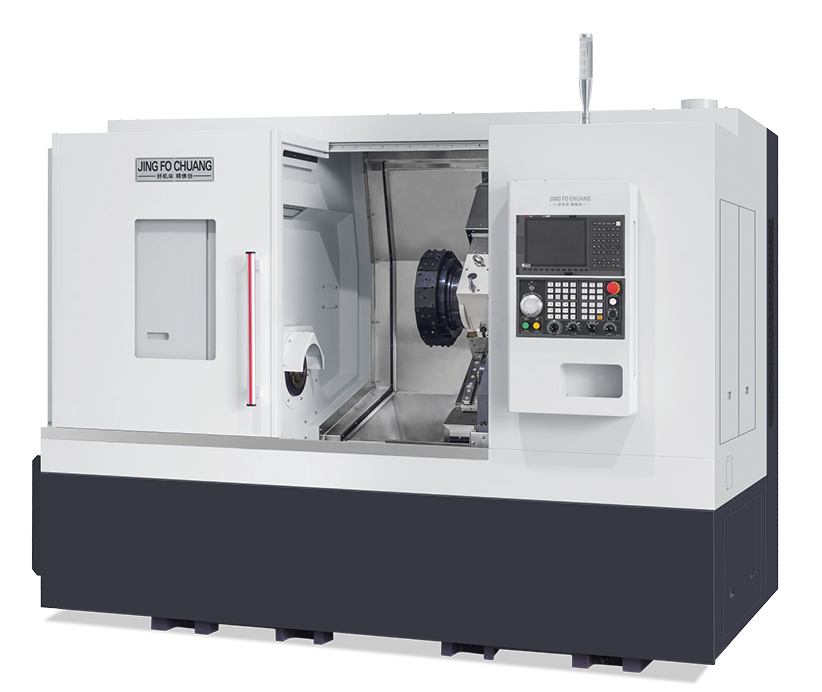
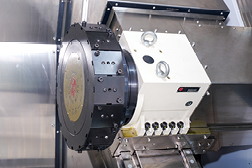
1. Significant Improvement in Processing Efficiency • Dual-Spindle Parallel Operation: Two workpieces can be processed simultaneously (e.g., spindle A processes the left end, spindle B processes the right end), or workpiece flipping can be achieved through spindle docking, reducing idle time and increasing production efficiency by 50%~80% compared to single-spindle machine tools. • Power Turret and Y-Axis Interpolation: The turret integrates drive tools (milling cutters, drills, etc.), and with Y-axis (perpendicular to the spindle axis) interpolation function, complex curved surfaces, oblique holes, and spatial contour machining can be completed without switching to a milling machine, shortening the process flow. 2. Improvement in Machining Accuracy and Consistency • Multiple Processes Completed in One Clamping: Avoids positioning errors caused by multiple clamping (such as datum conversion deviations), especially suitable for parts with high requirements for coaxiality and perpendicularity (such as motor shafts, where coaxiality can be controlled within 0.008mm). • High rigidity structure and precision transmission: The machine tool bed is made of cast iron, and the spindle and turret guide rails are equipped with high-precision linear slide rails, combined with servo motor drive, to ensure smooth movement and positional accuracy during milling and turning processes.3. Strong process flexibility and adaptability• Multi-process integration: Supports composite machining such as turning (external diameter, end face, thread), milling (plane, groove, cavity), drilling, tapping, and boring, meeting the "full-process integration" requirements of complex parts.• Convenient programming: With dedicated CAM software, it can automatically generate multi-axis linkage machining programs, supporting standardized programming of G-code and M-code, adapting to small-batch, multi-variety production (such as customized parts in the aerospace field).4. Reduce production costs• Reduced equipment investment: One composite machine tool can replace multiple traditional lathes, milling machines, drilling machines, etc., reducing equipment procurement costs and workshop floor space (saving 30%~50% of space). • Optimize labor and management costs: Reduce the number of operators (one person can manage multiple machine tools), lower logistics and warehousing costs in the process flow, and simplify production planning and quality control processes.5. Suitable for batch and personalized production scenarios• Batch production: The dual-spindle alternating machining mode (one spindle processes while the other loads and unloads) achieves "unmanned" continuous operation, suitable for mass production of automotive parts, home appliance accessories, etc. (e.g., daily production capacity can reach thousands of pieces).• Personalized production: Through a rapid tool change system (the number of tool positions in the turret is usually 16) and flexible fixtures, different types of parts can be switched to be processed in a short time to meet the needs of small-batch, multi-variety orders (e.g., medical devices, mold parts).